DCS turns assessment evidence into a staged migration from Microsoft 365/Azure/Copilot, Google Workspace/Cloud/Gemini, ChatGPT, Claude, and other non-transparent AI services toward a data-resident DCS environment built around OpenDesk, open-source collaboration, and self-hosted Mistral private AI where appropriate.
Migration is governance work, not just data movement.
The goal is to bring critical information assets, access decisions, records evidence, collaboration spaces, export paths, AI workflows, and selected cost levers back under the organization's policies. DCS starts with the workflows where control and cost benefit overlap, while preserving compatibility with the tools users already know.
Target environment
OpenDesk plus private AI, delivered as an operating model.
The target can include OpenDesk components such as Nextcloud, Collabora, XWiki, OpenProject, Matrix/Element, Jitsi, OX App Suite, Nubus/Keycloak-style identity integration, and a DCS private AI gateway using Mistral where appropriate.
Delivery model
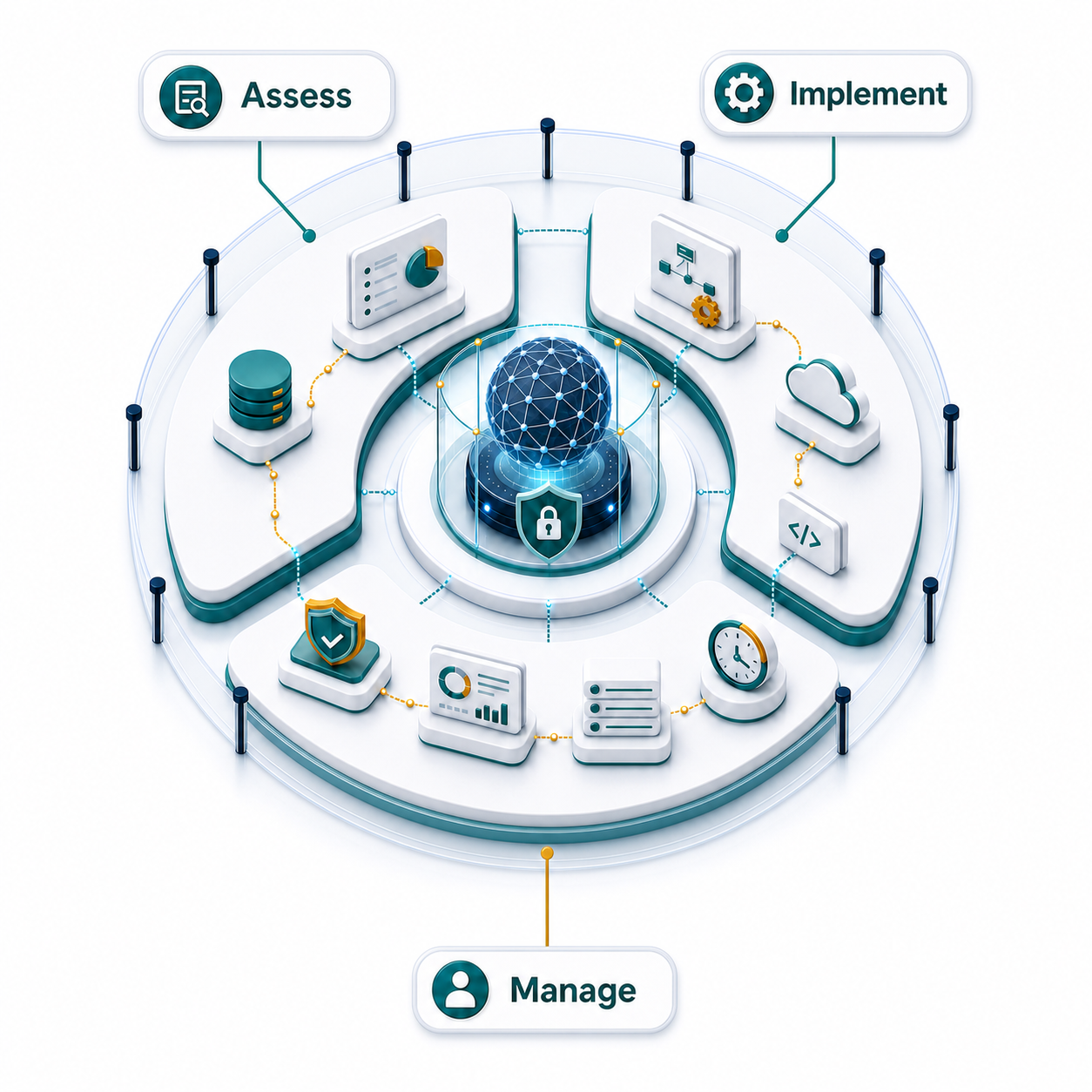
From assessment to implementation to managed control.
The implementation work turns assessment evidence into a controlled pilot, validates adoption and cost assumptions, then prepares the environment for trusted managed operations.
High-level project plan
A staged path from assessment to production.
W1
W2
W3
W4
W5
W6
W7
W8
W9
W10
W11
W12
Discover and Design
Scope, risks, architecture
Build Foundation
Platform, identity, backup
Configure Governance
Roles, audit, retention
Migrate Pilot Workflows
Files, records, knowledge
Enable Private AI
Mistral, RAG, permissions
Validate and Handoff
Test, train, operate
Implementation scope
Designed for controlled coexistence first, expansion second.
Target-state architecture and migration strategyMicrosoft, Google, Copilot, Gemini, ChatGPT, and Claude dependency mappingLicense transition, cloud waste, and AI token-control planningOpenDesk and open-source workplace designIdentity, SSO, MFA, roles, groups, and privileged accessData-resident storage, collaboration, knowledge, and records workflowsMistral-enabled private AI and RAG designSecurity, audit logging, backup, retention, export, and recovery baselineTraining, adoption, go-live, and managed-services handoff
Deliverables
What clients receive.
Target architecture
A practical design for the DCS environment, coexistence model, identity integration, and platform components.
Migration wave plan
A phased plan for moving sensitive workflows while validating license, cloud, and AI spend assumptions.
Pilot environment
A working DCS environment for selected data, communication, knowledge, project, or AI workflows.
Operations handoff
Runbooks, test evidence, support process, and readiness package for DCS Managed Services.
Next step
Turn assessment findings into a controlled pilot.
DCS Design and Implementation Services are the bridge between strategy and production. The best first project is usually a board workspace, secure data room, private AI assistant, or records-heavy collaboration workflow where control, adoption, and cost evidence can be proven together.